
Build Your $300K Flywheel
No matter how successful you become as a freelancer, consultant, or agency founder, the problems never stop coming. Just because something is wrong doesn’t mean you did something wrong.
So if you want to keep growing past the $60K, $120K, and $240K milestones, then you have to keep fixing problems. The challenge is knowing which problems are important enough to solve.
A business model like an engine schematic helps with this. It gives you a clear picture of how all of the parts fit together and which ones you’re missing.
However, not just any business model will do. What we sell, including taste and creative skills, expertise and problem-solving, advice and done-for-you services, is different from selling commodities like toilet paper or undifferentiated services like a coin laundry.
Certain ideas and frameworks are fundamentally misaligned with the way our businesses work, and we get ourselves into trouble when we apply them. We make short-sighted decisions like trying to be a one-stop shop or trying to compete based on price.
When I couldn’t find a business model that fit what I have learned through trial and error over my 17 years of freelancing and consulting, I created my own. It’s called the $300K Flywheel.
The $300K Flywheel is the foundation of both the Freelance Cake Community that I lead and the one-on-one freelance business coaching that I do.
I’ll explain the most important parts below.
If this framework helps you understand your business more clearly and you want to build your own $300K Flywheel, then email my team (helloatfreelancecakedotcom).
This framework is helpful for “accidental” business owners.
I finished my Master’s degree in poetry writing, got a full-time job, and got laid off six months later. Suddenly I had to figure out how to pay my bills without knowing much of anything about running a business.
Because I didn’t know what I was doing, I tried to work my way out of problems. Most of that effort and time was wasted, the same as if I were pumping more fuel into a very inefficient engine.
I did figure out the business side of things, and you can too.
The key is remembering that you’ve already done harder things. Growing up is harder. Being a parent is harder. Grief, illness, and aging are harder.
You can do this.
You can have the income, time freedom and lifestyle you want if you commit to building a profitable, efficient business. The real fuel isn’t time but clarity, conviction, and commitment, and the $300K Flywheel helps you know what you’re committing to and why.
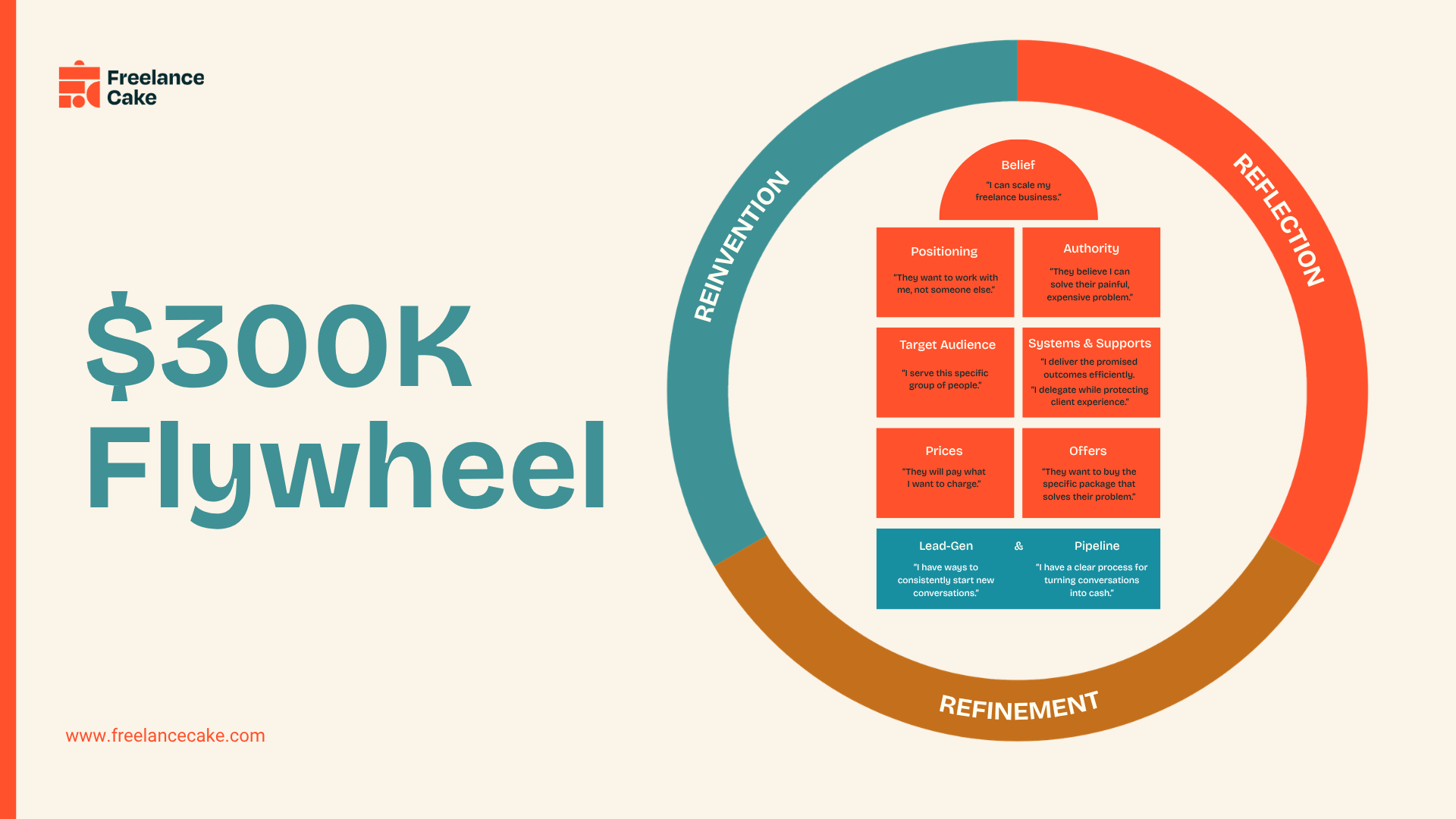
Belief - “I can scale my freelance business.”
You need clarity about what to do before you can have conviction to do it, and you need that conviction before you can make the commitment that carries you through obstacles and setbacks.
Your confidence in yourself and your path becomes sunscreen that protects you from UV rays in your environment.
On the other hand, if you lack confidence in your ability to grow your business, then you will struggle to grow your business. If you believe that entrepreneurship has a dismal future, then you will struggle to grow your business. You’ll self-sabotage in a dozen subtle ways.
So the outcomes we get often have more to do with the strength of our belief than with the level of knowledge or talent we had at the outset.
You’ll never have the certainty you think you need, but you can learn how to move forward confidently without it.
Four specific practices build our confidence:
- Make faster decisions.
- Take messy, imperfect action.
- Do it scared because the fear never really goes away.
- Measure progress backward against how far you’ve come.
Just how determined are you to make this whole freelancing thing work? The answer matters more than you think.
Positioning - “They want to work with me, not someone else.”
In simple terms, your positioning is the place you occupy in your market, in relation to your closest competitors and to your clients’ problems.
If you have weak positioning, then you have to find clients at exactly the right time (meaning before anyone else) or compete based on price.
If you have strong positioning, then your clients prefer you over their other options, and price becomes less of an object.
If you’re a generalist without a target market or specialization, then you don’t have positioning in any meaningful sense.
That’s okay if you get in touch with a client and convince them that you can solve their problems. It’s also okay if they come to you through a referral, and they don’t shop around.
As great as referrals are, being too dependent on them isn’t great. Eventually, you’ll have a lean month or six, and no matter how hard you shake the referral tree, nothing falls out.
You’ll be faced with the painful truth that your business will remain fragile until you find other ways to generate leads predictably. And in the absence of the borrowed trust or halo effect of a referral partner, you need strong positioning.
Your positioning consists of the following:
- Your key differentiators
- Client problems (or, unpleasant facts of their situation)
- Client pain points (or, their feelings about their problems)
- Functional benefits (or, what the clients get through working with you)
- Emotional benefits (or, the emotional or qualitative differences they experience through working with you, as in relief, hope, pride, clarity, momentum, renewed passion, etc)
Positioning is only half the trust equation though. You need authority too.
Authority - “They believe I can solve their painful, expensive problem.”
Sales is a transfer of belief, and when clients push back on your prices, approach, or recommendations, they’re saying, “I don’t fully believe that you can solve our problem.”
On the other hand, you know you’ve got authority when people do believe that you can solve their problem, and want you to tell them what to do, and then do it.
Think about a highly paid personal trainer or neurosurgeon. Their clients and patients don’t argue with them because it’s so obvious who has the six-pack and the know-how—and their advice is too expensive to ignore.
You build authority by publishing, or making public, your expertise:
- Show how you think.
- Teach people something new.
- Make a confusing concept easier to understand.
- Point out limiting beliefs and help people upgrade them.
- Show proof that you solve your clients’ painful, expensive problems.
- Share valuable insights, ideas, perspectives, techniques, or approaches.
When you combine authority (i.e., people in your market believe that you can solve their problems) with positioning (i.e., clients prefer you over other options), then you will have an easier time charging a premium.
People don’t expect a good deal from experts.
Target Audience - “I serve this specific group of people.”
Freelancers who don’t serve a specific market, industry, or target audience are playing the freelance game on hard mode.
You’re welcome to disagree with me, but I know all the rationalizations because I stubbornly stayed a generalist for seven years:
- “I get bored easily.”
- “I’m good at a variety of things.”
- “Being a generalist is truer to who I am.”
The real reason I stayed a generalist wasn’t because I was more versatile, honest, or authentic than my specialist peers but because I doubted my ability to niche down and generate enough leads.
I was too afraid to use a proven strategy (i.e., niching down) despite overwhelming evidence that it produced superior results.
Had I ever met anyone who regretted niching down? Nope.
After I finally bit the bullet, I found it easier to identify decision-makers and start conversations with them. Shocker.
Equally non-shocking is the idea that hungry customers with money to spend are easier to sell to. So pick a “starving crowd” that meets the right criteria:
- The decision-makers can afford your fees.
- They’re in a growing market as opposed to a shrinking one.
- They’re aware of their problems and in enough pain to take action.
- They’re relatively easy to start conversations with or get in front of.
Keep in mind that you can still take on clients and projects outside your target audience when they find their way to you. You don’t have to stop being a generalist if you don’t want to—go hog wild—but you do need to start being a specialist.
If you don’t make yourself easy to remember by picking your spot in the bento box, then you make yourself easy to forget.
Systems - “I deliver the promised outcomes efficiently.”
A freelance business has two main systems: Growth and Fulfillment. Each one is made up of various processes.
Some people are naturally good with systems and processes. (If you’re one of them, I admire you and also find you a bit annoying too because I’m envious.)
Other people like myself excel at raw creativity but find it difficult to document the steps they follow and then follow those steps after they document them.
We treat improvisation as though it’s a virtue when in fact it is a symptom of being allergic to boredom and addicted to novelty and chaos.
You can grow from $60K all the way up to $200K through dogged effort, but unless you are naturally good with systems, you will grow the messes and headaches along with the revenue.
Disorganized, inefficient businesses leak opportunities. They waste time and money. They grind you down with needless complexity.
Conversely, streamlined processes that fit together in reliable systems make it easier to turn a profit reliably even when the quality of your focus, energy, and creative output varies.
If you want to scale your profit and time freedom—as opposed to just growing revenue—you must document your processes and stick to them.
Support - “I delegate while protecting client experience.”
You’ll eventually reach a point where you’ve got no more lumps of coal to feed the machine. You can’t leverage your productivity any more without burning yourself out.
Or, maybe you’ve realized that you don’t want to be more efficient. No matter what the hustlebros on LinkedIn say, there’s more to life than work, and more to work than making money.
You and I are not assembly lines at a factory to be calibrated and optimized.
We want to do things that benefit the business in no way whatsoever: Read Dungeon Crawler Carl. Write a sonnet so uninspired it causes the death of a distant star. Nap.
So if we want to keep growing beyond our personal capacity, then we learn to delegate. You can agree with that statement and still have limiting beliefs like these:
- “I can’t count on other people.”
- “I can’t afford to get more support.”
- “No one can do it better than I can.”
- “My clients want to work directly with me.”
- “I already tried using subcontractors. It was a disaster.”
Fact: People less intelligent than you have successfully delegated work more complex than yours.
Fact, the Sequel: You can figure out delegation if you want to.
Besides, you don’t start by delegating important parts of high-stakes projects. You start by delegating low-leverage, high-frequency tasks that you don’t particularly enjoy, aren’t exceptionally good at, or that don’t require your multifaceted expertise:
- Research
- Data entry
- Inbox management
- Project management
- Calendar management
If those possibilities don’t tickle your fancy, then get inspired by this list of 101 tasks to outsource.
The sooner you offload the operational and administrative grease that keeps the business moving, the sooner you free up time to make more money.
And most of my coaching clients and Freelance Cake Community members have to commit to getting support before they feel like they can afford it.
They have to create a point of no return situation for themselves.
P.S. If this idea of delegating what you don’t want to do intrigues you, ask me about my hiring playbook.
Offers - “They want to buy the specific package that solves their problems.”
Most freelancers, consultants, and agency founders sell generic services, such as copywriting, design, marketing, and now AI advisory.
That’s a pity because clients will pay more for juicy offers than for generic services. A juicy offer is an enticing, relevant, differentiated offer tied to a client’s painful, expensive problem.
Here are two examples:
- Food preparation is a service. Here’s a juicy offer: An unforgettable, seven-course dinner prepared by an award-winning chef and served by candlelight on the beach.
- Copywriting is a service. Here’s a juicy offer: A Not Stupid™ strategy overhaul, comprehensive landing page rewrite, and seven “story-as-proof” emails that lead to your best launch ever.
Do you have juicy offers and an offer ladder?
I recommend that creatives and consultants have three connected offers:
- Strategy offer that you sell first. It can be a mix of diagnostic, planning, and advice—for example, an SEO audit, marketing plan, or strategic roadmap. This initial offer positions you as an authority and sets you up to sell your signature offer.
- Signature offer that is your bread and butter. This is the bigger package of deliverables and outcomes that you want to be known for. It sets you up to sell your subscription offer.
- Subscription offer that generates you recurring revenue. You take the pieces of your signature offer that clients need most often and you deliver them on a monthly or quarterly basis.
My coaching clients have doubled, tripled, and quadrupled their project fees not by giving clients more deliverables but by raising the perceived value of outcomes with better “packaging” of juicy offers.
Listen to Robert’s story about that in this 13-minute podcast episode.
Prices - “They will pay what I want to charge.”
What you charge must make sense for your life, not someone else’s.
Creative and consulting projects have no set prices. They’re worth what clients will pay, and what clients will pay goes up or down based on perceived value.
Perceived value goes up based on your confidence, your positioning, your client’s current context, and what the transformation is worth to them.
You won’t really know for sure if you have smart, strategic prices until you figure out these key numbers:
- Survival Number
- True Availability
- Survival Rate
- Dream Number
- Dream Rate
- Pessimistic Price
- Weirdly Precise Price
Small hinges swing big doors, and small adjustments to your pricing can make a big difference in your income and optimism across a year.
More money means more options.
My book Free Money goes into much more depth on the subject of pricing and money mindset. You can buy it here.
Lead Generation & Pipeline - “I have ways to consistently start new conversations.” And, “I have a clear process for turning conversations into cash.”
The challenge I hear about the most is the feast-or-famine nature of freelance work. What we all really want is predictable income.
To have predictable income, you need a steady flow of project leads coming into your pipeline.
To have that steady flow, you must always be starting new conversations with people who can hire you or who can make introductions.
So the way that you get off the revenue rollercoaster is by turning lead generation into one of your core competencies. You must answer these questions:
- How will I start new conversations?
- How will I manage relationships?
- How will I close new projects?
It’s too easy to let marketing and lead-gen slip when you get busy with client work, so the only way you break the feast-or-famine cycle is by forming a Morning Marketing Habit that consists of a 20- to 30-minute sprint of effort I call the “Daily Apple.”
Depending on your bandwidth, you can scale your Daily Apple commitment down or up. An apple a day keeps the famine away.
Other than Free Money, the Freelance Cake Community, and one-on-one business coaching, my Morning Marketing Habit course is the most popular thing I’ve ever sold. If you join the Community, you get it for free.
Reflection, Refinement, Reinvention
From time to time, we need to slow down and reflect:
- “How is everything going?”
- “What is my effective hourly rate?”
- “How is my $300K Flywheel functioning?”
- “Am I working the right amount or too much? Why or why not?”
- “Am I making the money I want to be making? Why or why not?”
- “Has the market shifted on me? Am I adapting quickly? Do I need to refine certain parts of the business model?”
Sometimes, freelancers need to adapt to market shifts. At other times, everything is okay, so okay that we’re a little bored.
As I find my business boring, I’m always tempted to blow it up.
Boredom is a signal that the business is functional, sustainable, and profitable. It presented an opportunity for my client Ami who admitted, “I’m bored. I don't want this business anymore.”
I helped Ami see the advantages of separating her entertainment (love of the writing craft) from her livelihood (writing-based business), and this clear separation reduced anxiety, stress, and confusion while increasing stability and satisfaction.
Instead of burning it all down, Ami doubled down:
- Custom business roadmap to keep her focused because… ADHD
- New offer more in line with the work she wants to do
- Slightly higher prices but not so much higher that she lost clients
- New VA to do the most boring, repetitive things and free up more of Ami’s time for experiments and passion projects
We build profitable businesses that bankroll the lifestyle we want, and we also run small side experiments to figure out what else may be better.
This is a tension we live in, and experiment framing, including a hypothesis and end date, helps us avoid getting so distracted by experiments that we stop doing what was working to bring stability and profit to the core business.
Charlie Munger was fond of saying, “Avoid common ways of failing.” Regular reflection, refinement, and reinvention act as a hedge against self-inflicted chaos and upheaval.
How can you build your $300K Flywheel?
I created the first prototype of this framework in 2018, and in the years since, I have created the playbooks and templates that creatives and consultants need to build a $300K Flywheel, one piece at a time:
Community Member: “How do I craft strong positioning?”
Me: “Here are the steps.”
Coaching Client: “How do I create juicy Strategy, Signature, and Subscription offers?”
Me: “Use these playbooks, then I’ll give you feedback.”
It takes some work to graduate to the next level, and that’s why many freelancers never will. The problem isn’t that we’re lazy. The problem is that we’re afraid.
The fear never really goes away. We either do the work scared, or we never do it at all.
My commitment to my coaching clients and Freelance Cake Community members is that I will give them the tools, guidance, and relationships that make building a $300K Flywheel easier—not easy but easier.
You can do this.
In closing, it’s possible to have higher income without sacrificing your lifestyle. It’s possible to have your freelance cake and eat it too. But you’ve got to leverage a different growth strategy.
Building a $300K Flywheel is that growth strategy.
If you’re ready to build your $300K Flywheel, then apply for the Community here or apply for one-on-one coaching here.
One-on-one coaching includes 6 months of community membership as a bonus.
This post may contain affiliate links. Please read my disclosure for more info

About the Author,
Austin L. Church
Austin L. Church is a writer, brand consultant, and freelance coach. He started freelancing in 2009 after finishing his M.A. in Literature and getting laid off from a marketing agency. Freelancing led to mobile apps (Bright Newt), a tech startup (Closeup.fm), a children's book (Grabbling), and a branding studio (Balernum). Austin loves teaching freelancers and consultants how to stack up specific advantages for more income, free time, and fun. He and his wife live with their three children in Knoxville, Tennessee.